Centre for Excellence in Arctic Field Education (CAFÉ)
CAFE serves as a strategic hub for educational development at UNIS. Through seed funding, professional development, certification tools for field skills, and the revival of key educational activities, the centre will strengthen educational quality and collegial collaboration across UNIS.
active
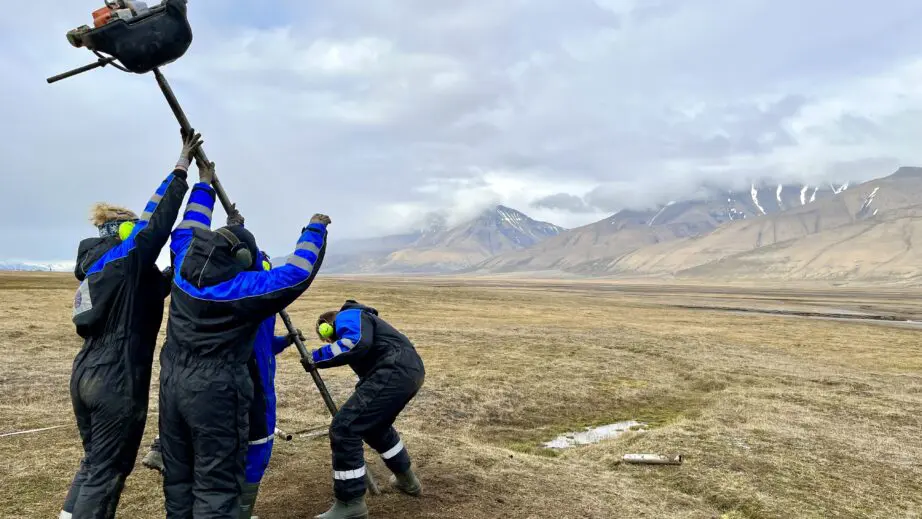
Students drilling in Adventdalen in the course AG-222. Photo: Marjolaine Verret/UNIS
We are actively recruiting students and staff from each department to serve as representatives in CAFE, and we have opened calls for SoTL project funding. If you would like to get involved in CAFE, please contact either the project lead or the project coordinator.
Building on the legacy’s from the BioCEED, iEarth and SoTL initiatives at UNIS, the Centre of Excellence in Arctic Field Education will be a one-stop shop for teacher- and student-oriented activities related to teaching and learning quality, and work closely with the study administration, general UNIS administration and OFS in areas where activities intersect.
CAFE will focus on four key areas of activity:
- Student Co-creation and the Student Learning Environment
- Quality of Learning for Educators and Staff Capacity Building
- the Scholarship of Teaching and Learning in the Field (FieldSoTL)
- and Educational Quality in Administrative and Technical Services
Each area is described in more detail below under Centre activities.
Project Info
Timeframe:
2026 –
Project lead
Maria Jensen, project leader
Christine Lockwood-Ireland, project coordinator
Funding:
The University Centre in Svalbard (UNIS)

Core activities to be provided through the centre from 2026
Develop the center as an entity at UNIS. This includes establishing the structure and management of the center and start operations.
- Develop student involvement,
- Establish seed-funding opportunities for students and staff-led SoTL projects towards the strategic objectives for education
- Re-establish student centered education activities such as UNISbreakfast, UNISOracle or UNISSprout
- UNIS-wide access to up-to-date knowledge on and sharing of best practice in field- and research-based teaching and learning and anchor collegiality as a fundamental principle of UNIS.
- Resources and support for a SoTL-based approach to field-based teaching and learning
- Fora and support for students to participate in co-creation of learning experiences.
- Support for development and implementation of tools for certification of scientific and inter-personal field skills. Ensure coordination of developed tools between courses/ departments.
- Coordinate all excellence in education activities at UNIS to ensure focus and promote synergies. This will allow UNIS to feed our unique expertise directly into educational programmes in e.g. Polhavet 2050 and IPY 5.
- Ensure that UNIS is connected to local, national and international projects and initiatives on field teaching and learning, learn from and transfer knowledge to other parts of the field learning practice and research community. Important partners are iEarth 2.0 (2026-2030), the STEM education research center at UiB) and international partners from iEarth and BioCeed
Centre activities
Activity area 1: Student co-creation / students learning environment
A very successful legacy from iEarth and bioCeed are several student-led actvities providing meeting spaces, ownership and participation in creating their own education experience. The centre activity should allow coordination of student groups and funding to continue some of the activities.
Core activities:
- UNISbreakfast (meeting area for all UNIS students for career development)
- Participation in co-creation activities for teaching and assessment (e.g. mid-semester evaluations until now, but could be other development as well)
- Participation in iEarth student activities, incl. strategic development of iEarth 2.0
- Establish a UNIS CAFÉ student group (either through the student council or a separate group like the iEarth student chapter, but for all UNIS)
- Support for UNIS students organizing SCOPE conference in October 2026. Students have proposed SCOPE 2026 as a national student conference, which will provide important exposure for UNIS and for example MSc of Polar Science.
Activity area 2: Quality of learning for educators and capacity building for staff
This work package should ensure coordination of activities, also across disciplines, provide specialised courses and workshops at UNIS where relevant, maintain an active collegial practice of teaching and learning, and actively engage in national collaboration on how to integrate/ export UNIS intiatives into national practices (e.g. Teaching Assistant (TA) course under discussion to be developed nationally for geosciences.
Core activities:
- Learning Forum
- Student Learning Area Elvesletta
- Teaching Assistant course (For Ph.D. studenter, masterstudenter og postdocs)
- Ethics course
- UPED collaboration with UiB
- Collegial Learning and Teaching course
- Writing course
- Field TA course
- Canvas toolkit
Some of these are already funded separately, but the center will ensure coordination and synergy between efforts.
Activity area 3: Science of teaching and learning in the Field (FieldSoTL)
It is a clear ambition of UNIS to carry out research on our own teaching and learning activities, and that the centre can serve as a framework for coordinating small scale SoTL activities, provide advice and connections to new employees with the assistance of the two adjuncts in university pedagogy.
Core activites:
- Seed funding for SoTL projects initiated by staff and students.
- Coordination and communication of seed project results, so this knowledge becomes available for use at UNIS, and is communicated to partners. Integration of best practices in UNIS teaching (e.g. trough learning forum or direct interaction with teachers).
- National and international collaboration with environments we already have strong contacts to (including leading environments in University didactics at UiB, iEarth 2.0, University of Copenhagen, KTH Lund, University of Lund, University of Edinburgh.
- Participation in UNIS-led and externally led grant proposals (in 2026 UNIS is already partner in Erasmus+ proposal DigiTrains).
- Collaboration funds – e.g., for travel to UiB SERG or STEM conferencesSeed funding for SoTL projects initiated by staff and students
- Coordination and communication of seed project results, so this knowledge becomes available for use at UNIS, and is communicated to partners. Integration of best practices in UNIS teaching (e.g. trough learning forum or direct interaction with teachers).
- National and international collaboration with environments we already have strong contacts to (including leading environments in University didactics at UiB, iEarth 2.0, University of Copenhagen, KTH Lund, University of Lund, University of Edinburgh.
- Participation in UNIS-led and externally led grant proposals (in 2026 UNIS is already partner in Erasmus+ proposal DigiTrains)
- Collaboration funds – e.g., for travel to UiB SERG or STEM conferences
Activity area 4: Educational quality from administration and technical services
Core activities:
- Learning resources and platforms
- Promoting and integrating learning resources developed through educational research (a knowledge centre for field teaching and learning resources).
- Access to tools and knowledge for development of learning resources (meeting areas between IT/ data storage and teaching staff).
- Administrative development of educational quality
- Study admin: educational quality, PhD duty work, student workload, learning areas.
- Emphasise – the role for this initiative: not to perform activities from the administration, but to: ensure flow of knowledge between results and experiences from SoTL work at UNIS to administrative implementation and provide access for administration to test and receive feedback on effects of initiatives.
- Canvas toolkit and best practice.
- Learning Forum.
- UPED courses etc.
- Collaboration funds – e.g., for travel to UiB SERG or STEM conferences.
- Educational quality from an OFS perspective
- Improve meeting arenas for collaboration and knowledge transfer both ways, through e.g. Arctic Safety center.