
UNIS marine biologists join the first Arctic Ocean 2050 expedition
Four marine biologists from UNIS are joining the very first expedition of the Arctic Ocean 2050 research programme. Before departure, we met Associate Professor Arunima Sen and PhD candidate Carla López Mateo to learn what they will be searching for nearly 4,000 metres below the surface, and why this expedition marks an important milestone for both UNIS and Norwegian polar research.
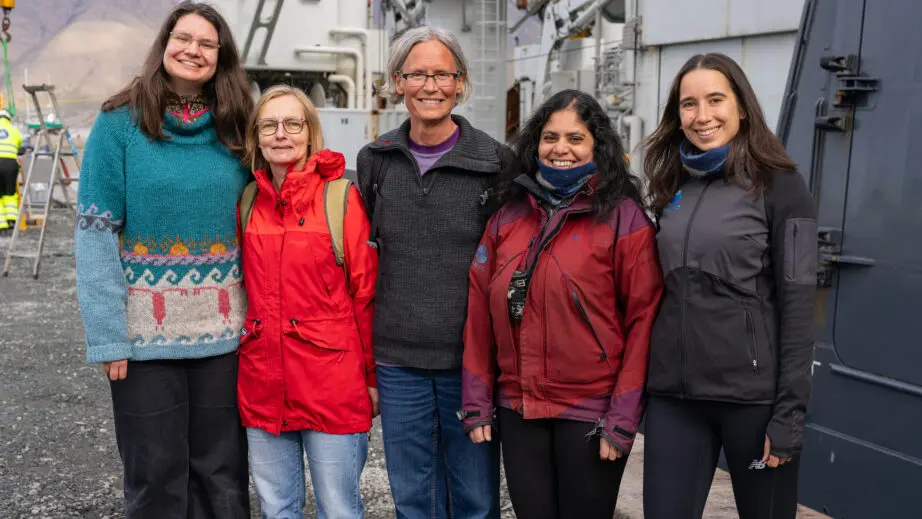
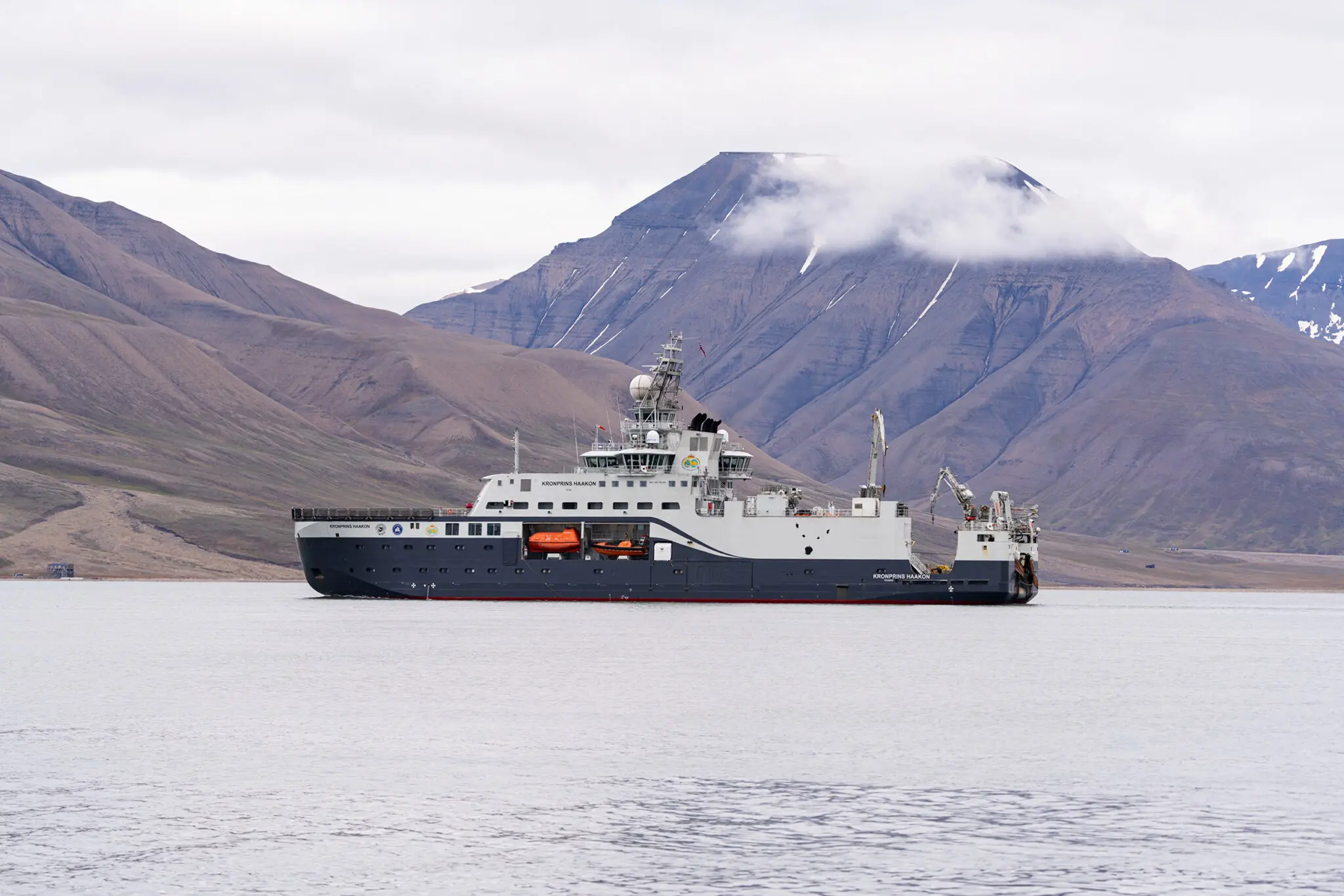
From left: Bergfrid Høgås Skjæveland, Sünnje Linnéa Basedow (UiT), Anna Vader, Arunima Sen and Carla López Mateo before boarding FF Kronprins Haakon. Photo: Ingrid Ballari Nilssen
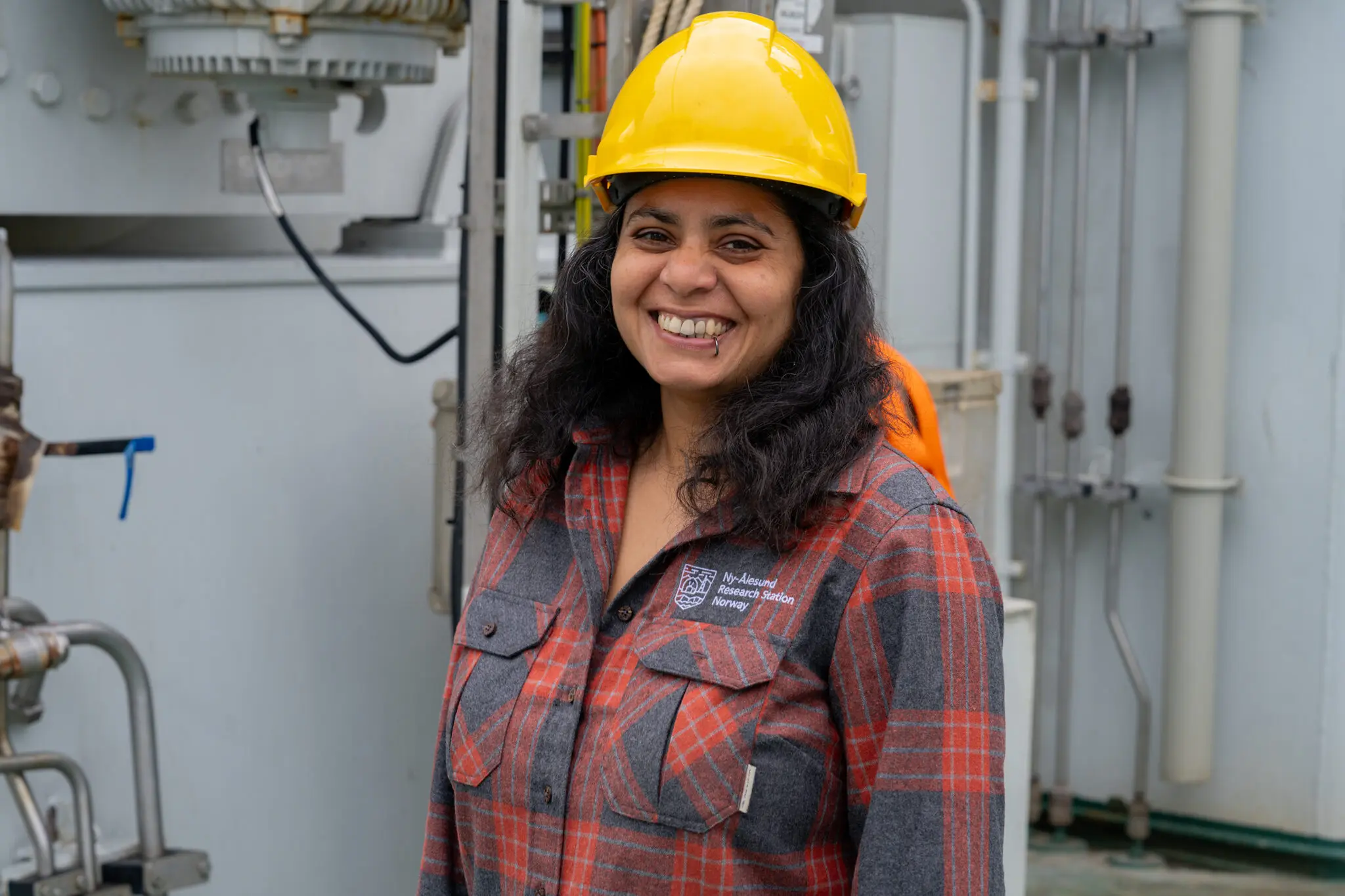
Associate Professor Arunima Sen at UNIS will lead one of the programme’s work packages. She also participated in the predecessor programme, The Nansen Legacy, and has built extensive expertise in her field. She emphasises the importance of a small institution like UNIS being involved in major national research initiatives, and that the value of UNIS extends far beyond its location and infrastructure.
UNIS also contributes highly relevant scientific expertise. Its year-round presence on Svalbard provides unique research capabilities that are essential to programmes such as this, she explains.
“This project helps put UNIS on the map as an academic institution, and we are very proud of that,” says Sen.
“We are a university centre conducting high-quality research. I also believe this demonstrates the strong confidence that our partners and the wider Norwegian research community have in the scientific expertise at UNIS. Being invited to participate in a project of this scale, with four researchers taking part in the expedition, means a great deal to us.”
In addition to Sen and López Mateo, Associate Professor Anna Vader and PhD candidate, Bergfrid Høgås Skjæveland, will also participate. Vader is likewise leading one of the expedition’s work packages.
Arctic Ocean 2050
Arctic Ocean 2050 brings together 18 Norwegian research institutions. The Norwegian government is investing NOK 1 billion in the programme, and when the participating institutions’ own contributions are included, the total investment amounts to approximately NOK 2 billion.
Tracking carbon 4,000 metres below the surface
Carla López Mateo and Arunima Sen will work on the benthic work package, focusing more specifically on carbon cycling at the seafloor. Sen leads this work package. Benthos refers to life on and within the seafloor, the researchers explain, and their task will be to collect samples for a wide range of analyses.
Their research investigates what happens to carbon once it reaches the seafloor. Deep-sea sediments represent one of Earth’s largest natural carbon reservoirs, and the team will examine how much carbon is stored in the sediments compared with how much is recycled back into the ecosystem.
“Is the carbon taken up by animals and microbes? Is it converted into biomass? Is it released back into the water column through respiration? Or is it buried and stored in the sediments?” Sen asks.
Careful and time-consuming work
The researchers expect long working days during the nearly two-month expedition. In the Amundsen Basin, where they sampled during previous expeditions, the water depth was approximately 4,000 metres, and they expect similar depths this time.
According to Sen, it takes around four hours simply to lower the equipment to the seafloor.
“We normally collect three replicate box cores at each station. Just retrieving the samples from the seafloor takes around twelve hours. After that, all the laboratory work is still ahead of us.”
López Mateo explains that they will collect everything from microbes to larger benthic organisms, including meiofauna and macrofauna. They will also take sediment samples to analyse both organic and inorganic contaminants, as well as collect environmental DNA (eDNA) samples to identify which organisms are present.
“In addition, we incubate sediment cores to measure the oxygen consumption of the organisms living in the sediments. This helps us understand how these communities function and how they process carbon.”
A collaboration involving 18 research partners
Sen emphasises that they are not collecting samples solely for their own research. Their team also serves as the sampling group for numerous other research teams within the consortium.
Some of the work is directly linked to their own research. López Mateo specialises in meiofauna, which are tiny animals that live between sediment grains, while Sen focuses on the somewhat larger organisms that are visible to the naked eye.
“I am also responsible for the respiration experiments, where we measure oxygen consumption. This tells us how much carbon is released back into the ecosystem.”
The work packages are closely connected. While Arunima and Carla focus on what is happening on the seafloor, Anna Vader and Bergfrid Høgås Skjæveland will work in the water column.
Bergfrid’s main focus is on the copepod Calanus, a small crustacean only a few millimetres long. These copepods feed on the microorganisms that Anna Vader studies, so everything is connected, Skjæveland explains.
These copepods are rich in lipids and are an important food source for other animals, such as fish and seabirds.
“I will study how many of them there are and how much lipid they contain to understand how much food is available for the other animals in the Arctic Ocean,” she says.
Anna Vader studies even smaller organisms. She filters seawater and then uses molecular methods to identify which microorganisms are present and how abundant they are.
Microorganisms make up around 70% of the ocean’s biomass and account for most of its biodiversity. All other life in the ocean depends on these microbes, making it essential to understand who they are, what they do, and how different species are distributed throughout the Arctic Ocean. Are there, for example, biodiversity “hotspots” that should receive special protection?
Arunima explains that this work is also relevant to the research taking place on the seafloor.
“One of our projects investigates seafloor food webs using stable carbon and nitrogen isotopes. To interpret these measurements, we need reference values from the water column,” Arunima explains.
Some of the filters collected by Anna will provide exactly these reference values. As a result, her work becomes an important part of our studies of food webs on the seafloor.
A shared effort towards a common goal
For López Mateo, one of the most important aspects of the programme is its overarching scientific objective.
“We need to establish a baseline for what Arctic Ocean ecosystems look like today. By 2050, the central Arctic Ocean is expected to be far less ice-covered than it is now. Before that happens, we need to understand the ecosystems that exist today so that we can assess how they change in the future.”
She also highlights the collaborative nature of the programme as one of its greatest strengths.
“The sheer number of different sediment samples we will collect demonstrates how many scientific disciplines are involved. I like that everyone is working towards one common goal, rather than each research group working independently.”
The expedition will also visit areas that were not explored during The Nansen Legacy.
“During The Nansen Legacy we mostly travelled straight north. This time we will investigate completely new regions and new water masses. We will, among other places, reach the Transpolar Drift, which transports water across the Arctic Ocean, and it is an area we have not studied before,” says Sen.
A unique opportunity for early-career researchers
For PhD candidate Carla López Mateo, this will be the largest research expedition she has ever participated in.
“Absolutely. Just having the opportunity to travel to the North Pole is incredible. Being away for nearly two months makes the experience even more special. I will also be working on tasks beyond my PhD project, so I expect to learn an enormous amount.”
She admits that she is also feeling some nerves.
“It is a long expedition and a big responsibility. At the same time, I think the people around you matter most. Even when things do not go according to plan, everything becomes much easier when you have a good team.”
Sen is also hoping for a particularly memorable moment if everything goes according to plan.
“I hope Carla and I get the opportunity to stand at the North Pole, each holding our own flag. I do not think many people have stood there with an Indian flag and a Catalan flag, and perhaps never together. That would be quite special.”