
Government Commits NOK 1 billion to Polhavet 2050
The Norwegian government has committed NOK 1 billion to the Polhavet 2050 initiative, a ten-year research effort uniting 18 institutions, including UNIS. The project will address climate, environment, industry, security, and preparedness in the rapidly changing Arctic.
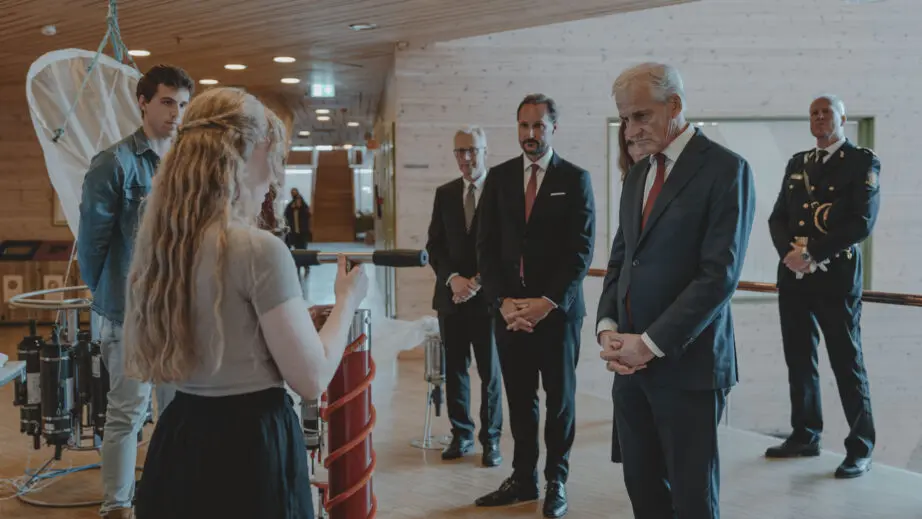
Støre visiting UNIS in August together with H.R.H Crown Prince Haakon and the minister of justice Astri Aas-Hansen. Photo: Ragnhild Utne
Tromsø, August 27, 2025 – At a press conference at the University of Tromsø, the Norwegian Prime Minister announced that the government will allocate NOK 1 billion to the Polhavet 2050 initiative over ten years, from 2026 to 2036.
This investment marks a major milestone for Norwegian polar research and highlights the need for a broad, coordinated effort to understand the rapid changes occurring in the warming Arctic. The funding will be phased in through the Research Council of Norway.
“Within our lifetime, the ice-covered Arctic Ocean will be blue and open for several months of the year. This will be the greatest natural change modern humans have ever experienced. The consequences of this for global food production and regional climate are completely unknown. And this is what we need to find answers to,” says Jøran Moen, Director of the University Centre in Svalbard to the local newspaper Svalbardposten.
The Polhavet 2050 initiative brings together 18 research institutions, including UNIS. All partners are expected to contribute equally in terms of research and educational efforts. Key research themes include climate, environment, industry, security, and preparedness.
UNIS is strategically positioned to play a vital role in the collaboration due to its location, expertise, and role as a recruitment arena for future polar researchers. The initiative is expected to generate positive ripple effects for Svalbard and Longyearbyen, while strengthening Norway’s position as a global leader in polar research and international cooperation.
Moen also emphasises that the project’s pioneering spirit will make Arctic research especially attractive to students: “This initiative will inspire and recruit the next generation of Norwegian polar scientists.”