
Ethics and reflection in geoscience: an interview with Mark Furze and Lena Håkansson
When former colleagues Mark Furze and Lena Håkansson met as PhD opponents in Oslo, they quickly agreed on one thing: teaching landscape ethics should be an integral part of geology education.
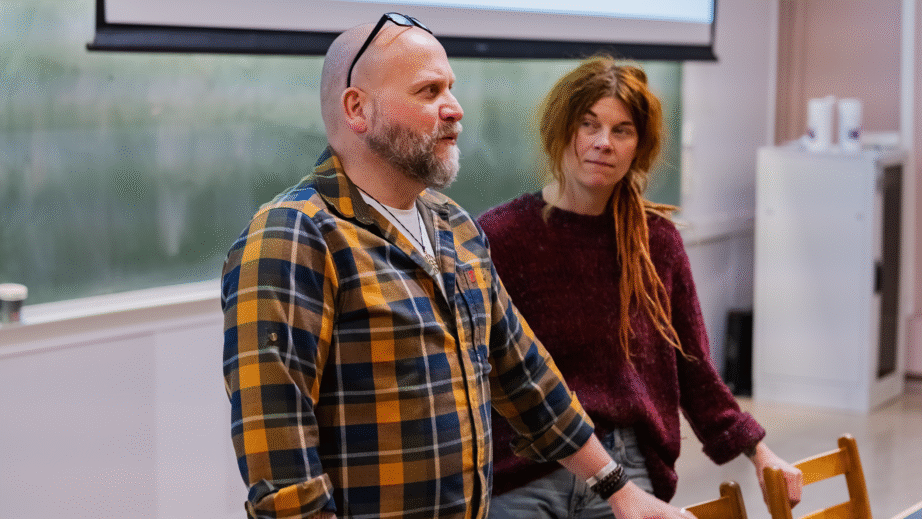
Mark Furze and Lena Håkansson teaching field ethics — a novel approach to geoscience education. Photo: Ingrid Ballari Nilssen
Shortly after, Håkansson made a brief return to UNIS, teaching field ethics to Mark’s students. The goal was to bring theory, reflection, and empathy into the Arctic landscape. Both educators argue that it is time to integrate ethical perspectives into the natural sciences, particularly in locations like Svalbard, which has a history marked by extraction and resource exploitation.
Lena worked in Longyearbyen and UNIS from 2014-2020, where she contributed to the implementation of iEarth- the centre for integrated geoscience education. Throughout her career, she has been committed to transforming theoretical subject matter through active, experimental and relational learning methods. Her teaching challenges the students to view the landscape as an active participant in the process of knowledge-making, rather than a passive object. This approach reframes the traditional human-centred science and opens toward a relational ontology in which humans and environments exist in mutual relation to each other.
Although there was no formal requirement, Mark introduced ethics into the course description a couple of years ago. “There was no external requirement driving this, but I sensed that there was a need for this — to encourage students to think about how they relate to their work as geoscientists.”
This represents a Bourdieuan reflexive approach in science: recognising research not as neutral observation, but as a relational practice in which the researcher is always part of what they study. As Mark notes, “We are not robots. Landscape, weather, and materiality shape the researcher both physically and epistemically.”
Lena also highlights the colonial tendency within Western research culture, where the scientist assumes the role of the primary narrator and the landscape becomes silent, spoken about but never allowed to speak with. As she puts it, “Each science has its own language… but it’s strange to tell the story of the Earth and leave out the voice of the landscape.”
Fieldwork thus becomes more than mere data collection; it is a dialogue between humans and the environment. Recognising this relationship entails ethical responsibility — especially in our current age.
Unlike regions with indigenous communities, Svalbard lacks the traditional ecological knowledge that has developed over generations of living with the land. In this absence, researchers must become the landscape’s spokespersons. Ethical awareness is increasingly expected by major funding agencies, as well as the Norwegian Research Council, which all require statements on impact, inclusion, and responsibility. As Furze puts it, field ethics is about establishing the right relationship with the landscape.
“If you were in northern Canada or Norway or Sweden… where Indigenous people have been for so long, they have stories about the land, they collaborate with the land to live with it. Here in Svalbard it’s easy to say: there was nobody here, so we can take whatever», Lena elaborates.

Field ethics: more than sampling
For Mark, field ethics is not about prohibiting sampling; it is about treating the landscape as an active collaborator, rather than an inert object. The discourse in geoscience tends to objectify its subject matter, leading to a “truth regime” that views the landscape as passive and uncommunicative.
Mark shares an anecdote about students rushing from the boat toward an iceberg, with hammers in hand, eager to extract samples without considering the iceberg’s significance or its beauty. He aims to challenge his students to examine their ontological perspectives and confront the human exceptionalism often present in scientific research.
For those students, the iceberg was merely an object of study. In that moment, the landscape became something separate from themselves, something to be possessed. However, for Mark and Lena, the goal is to demonstrate that the ice can be viewed as a presence rather than just a material resource. It serves as a participant in the shared conditions that make fieldwork possible.
Taking a moment to pause before striking is a way to recognise the relationship between land and humanity. What the students encountered on the shore was not simply frozen water; it was a reminder that the world does not remain still, waiting to be understood. Instead, it interacts with us, and we engage with it, both in motion.
Field ethics thus serve as a counter-discursive effort aimed at transforming the language of science. This transformation seeks to acknowledge nature as an active participant in the process of knowledge creation.
“It’s about behaving in a way that is respectful and that recognises value independent of what we, as scientists, perceive,” Mark explains. “It’s about a partnership — actually viewing your sample as a collaborator.”
He describes geoscience as “incredibly acquisitory” — a discipline with aspects of trophy hunting, where large quantities of samples are collected, often to be stored and forgotten.
“We may not even use the samples… they might sit in a cupboard for 30 years and then be discarded. It’s about trying to address that one-sided equation and aim for a more balanced and less colonial approach.”

Fieldwork as an exercise in empathy
Lena Håkansson emphasises that teaching landscape ethics involves both sensory and embodied learning, as well as theoretical understanding. Through role play, students practiced speaking on behalf of glaciers, rivers, permafrost, or fjords, collectively composing a message from the landscape to those who inhabit it.
“Role play can be a pedagogical tool for practising empathy — taking the perspective of other entities,” says Håkansson. “Students learn through sensory experiences — touching, feeling, and even swimming in the mud. They don’t just bring materials home in bags; they have it under their nails and in their hair.”
Students engage physically with the landscape and reflect on what they take away — not just samples, but also memories and emotions. “This is an exercise in empathy,” Lena affirms. “When taking something from someone — whether from the landscape or an office — it comes with responsibility.”
Ethics beyond the human
For both Mark and Lena, landscape ethics also entails expanding the scope of ethics itself. Traditionally, ethics has focused on relationships among humans. Today, researchers must also consider their relationships with other-than-human entities.
“Ethics used to concern how humans relate to other humans. Now, landscape ethics compels us to think about our actions toward non-human agents,” says Mark. ” While that’s something we humans raised in the western enlightenment tradition need to relearn — it’s knowledge we’ve had as a species for the longest time. Do things outside of humanity possess inherent value simply by existing? I would argue that they do.”
A geologist often perceives nature as an object rather than a relationship. By encouraging students to reflect on their own position in the field, Mark and Lena challenge the scientific habitus, creating space for reflexivity and relational thinking within a traditionally objectivist discipline. The work that they initiated at UNIS points toward a broader shift taking place in the natural sciences, where researchers move away from treating the landscape as a static backdrop to treat it as a partner in the knowledge production. Through embodied learning, role-play, theoretical framing, and reflexive practice, they invite students to rethink what it means to encounter the landscape as geoscientists. In helping students cultivate this awareness, Mark and Lena are not only teaching better science; they are nurturing a more responsible, grounded, and relational way of being in the world.