
Disputation: Samantha Paige Huset Dwinnell
Dwinnell will defend her doctoral thesis from the Faculty of Environmental Sciences and Natural Resource Management, NMBU, at UNIS on 29 August 2025. Her research explores how climate change affects the food supply and foraging strategies of Svalbard reindeer, shedding light on the adaptive capacity of large Arctic herbivores in a rapidly warming environment.
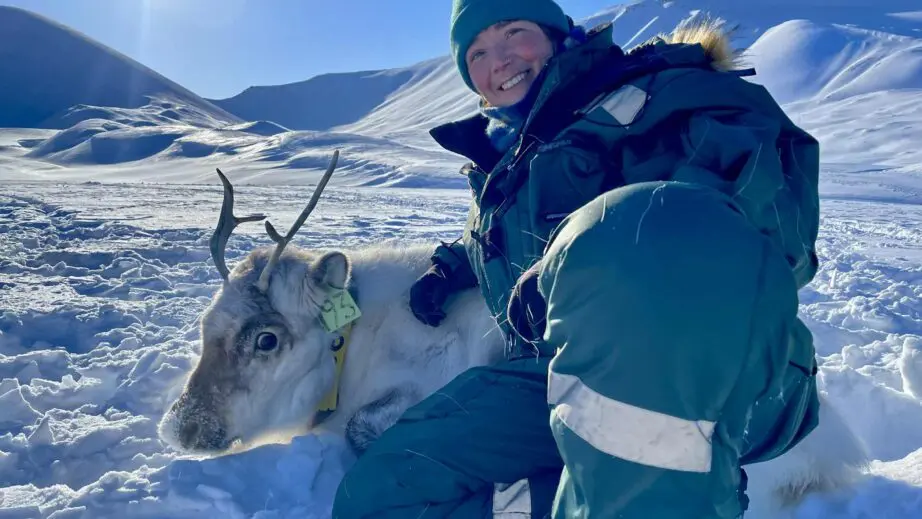
Photo: Samantha Paige Huset Dwinnell
Dwinnell has been following the PhD programme at the Faculty of Environmental Sciences and Natural Resource Management, NMBU, and is defending her doctoral thesis at UNIS 29 August 2025:
«Herbivore responses to climate-driven food supply in a warming Arctic: nutritional benefits and adaptive foraging strategies of Svalbard reindeer»
The doctoral thesis is available for public review. For those of you who want access to the thesis in pdf-form, please send an email to Brage Monsen – brage.monsen@nmbu.no.
Public summary:
Large herbivores in Arctic regions, such as Svalbard reindeer (Rangifer tarandus ssp. platyrhynchus), have adapted to seasonal food supply using energy stores (e.g., fat) gained during summer periods of abundance to finance survival and reproduction through long winter periods of food scarcity. Climate change is altering plant growth and timing of availability, creating a more variable and less predictable food supply for reindeer relying on it. We explored the connections linking weather- and climate-driven shifts in food availability to the behavioral and fitness-related responses of Svalbard reindeer in the fastest-warming region on Earth. Using a combination of long-term, monitoring of individual reindeer behavior and body condition, on-the-ground measurements of plant growth and ground ice, and remotely sensed data on broader environmental conditions, we began to uncover the mechanisms linking climate to a 3.5-fold increase in Svalbard reindeer over the past 26 years. This body of work demonstrates that high-Arctic reindeer have benefited from positive plant responses to warming and exhibit flexible foraging, likely enabling adaptive responses to rapid environmental changes. This resilience may persist as long as warming remains within their adaptive thresholds, but continued Arctic warming could challenge these benefits, underscoring the need for ongoing research on large herbivore responses to climate change.
Opponent ex auditorio:
Questions ex auditorio can be submitted to Disputation Chair prof. Jan Vermaat
Disputation 29 August 2025
Trial lecture: 12:15
Title: “The nutritional nexus: Changes in the geochemistry of soils and plants and the implications for Arctic wildlife”
Disputation: 13:15
Where: Lassegrotta
Want to follow the lecture and disputation online?
Assessment committee
First Opponent:
Professor Isabel C. Barrio, Agricultural University of Iceland, Iceland)
Second Opponent:
Dr. Floris M. van Beest, Aarhus University, Denmark
Committee coordinator:
Professor Kathrine Eldegard, MINA/NMBU
Disputation chair
Jan Vermaat, NMBU
Supervisors
Main Supervisor:
Professor Leif Egil Loe, NMBU
Co-supervisors:
Associate professor Larissa Beumer, UNIS
Professor René van der Wal, Swedish Uiversity of Agricultural Sciences
Dr. Åshild Ønvik Pedersen, Norwegian Polar Institute