
AGF-804 Radar Applications for Space Research (15 ECTS)
ID:
AGF-804
CREDITS:
15 ECTS
APPLICATION DEADLINE:
October 01, 2026
START DATE:
January 06, 2027
END DATE:
June 04, 2027
COURSE PERIOD:
Spring semester. Teaching block 1-3
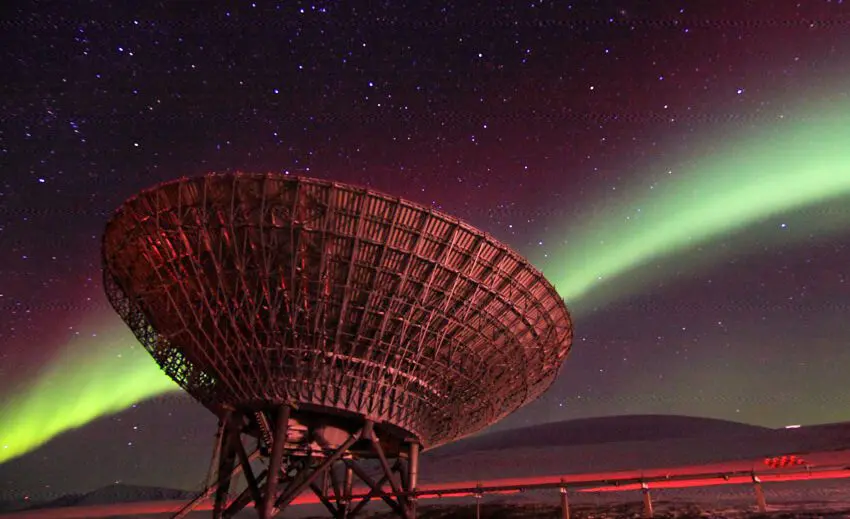
Northern lights (Aurora Borealis) over the EISCAT Svalbard Radar. Photo: Njål Gulbrandsen/UNIS.
Note: This course will not be offered in 2025
| Grade: | Letter grade (A through F) |
| Course Cost: | None |
| Course Capacity Min/Max: | 8/16 students (AGF-304/804 in total) |
| Language of instruction: | English |
| Examination support material: | Bilingual dictionary between English and mother tongue |

Course requirements
Enrollment in a relevant PhD programme in geophysics. General knowledge of basic atmospheric physics and/or electrodynamics. Priority will be given to students with knowledge of ionospheric/space physics or are enrolled on a study program focused towards ionospheric and/or space physics.
The course should be combined with AGF-801 The Upper Polar Atmosphere. The two courses are designed to complement each other.
Academic content
Explore how powerful radar systems can be used to investigate the ionosphere and unlock the physics of near-Earth space. In this course, you will build a strong foundation in polar ionospheric science, plasma physics, radar design, and incoherent scatter theory, while learning how radar signals are processed and turned into meaningful measurements of space plasma properties. The course also covers key mathematical and statistical methods used in signal analysis and discusses how radars use different pulse coding techniques. The course will focus on both incoherent and coherent ionospheric scatter radars such as EISCAT and SuperDARN but the techniques are also applicable to other radar systems such as the AMISRs and EISCAT-3D.
By the end of the course, you will not only understand the theory underpinning how complex radar systems work but also be able to operate a radar as part of a team, analyse multiple datasets, identify signatures of ionospheric processes, and communicate scientific results through discussion, presentations, and written reporting.
This is a course for students who want both scientific depth and practical experience. It offers the opportunity to engage with the theory, instrumentation, and analysis techniques that drive modern ionospheric and space plasma research, while developing the ability to operate radar systems, analyse complex datasets, and interpret the signatures of physical processes in the upper atmosphere.
Learning outcomes
Upon completing the course, the students will:
Knowledge
- have detailed knowledge of radar techniques employed in the field of space plasma and ionospheric physics research, including radar design, incoherent scatter plasma theory, pulse coding techniques, and signal processing
- be able to evaluate and discuss the methodology by which ionospheric plasma parameters can be derived from an auto-correlation function
- be able to discuss the mathematical approach of the dressed particle theory and evaluate the statistical methods utilized in signal analysis
- be able to interpret and discuss incoherent scatter radar data in the context of ionospheric and magnetospheric processes.
Skills
- operate an incoherent scatter radar independently
- utilise the radar data analysis package (GUISDAP) in analysing multiple data sets
- analyse data and recognise the different analysis techniques employed and know the advantages and limitations of them
- discuss and describe orally the underlying physical principles surrounding incoherent scatter theory, pulse coding and signal analysis techniques
- apply scientific reasoning to interpret typical features that are observed in incoherent scatter radar data
General competences
- produce a short written report detailing radar analysis techniques and data interpretation
- give presentations of scientific papers from a peer reviewed journal.
Learning activities
The course extends over a full semester and is run in combination with AGF-304. Initially, students attend one week of compulsory Arctic survival and safety training (AS-101).
The main learning activities of the course are:
- lectures detailing the fundamental physical and mathematical techniques utilized in incoherent scatter radar theory including pulse coding and signal processing
- interactive seminars focusing on data interpretation
- data analysis techniques utilizing MATLAB and the GUISDAP analysis program
- five days fieldwork at the EISCAT Svalbard Radar where students will be expected to operate the radar using the radar control software
- produce a written report based upon analysis techniques and data interpretation.
Summary
- Total lecture hours: 60 hours.
- Total seminar and exercises hours: 16 hours.
- Preparation of oral presentation: 6 hours
- Total computer lab hours: 16 hours.
- Fieldwork at EISCAT Svalbard Radar: 5 days
Compulsory learning activities
All compulsory learning activities must be approved in order to sit the exam.
- Fieldwork
- Written report
- Oral presentation to peers
Assessment
| Method |
Percentage of final grade
|
| Oral exam | 100 % |
Student life
