NVA
UNIS gathers information about our scientific publishing activity in the national database for research information, NVA. The database has several features that are important to us.
NVA (Nasjonalt Vitenarkiv/National Research Archive) is the national system for documenting research activity at universities, colleges, and other research institutions in Norway. The purpose of the database is to simplify the reporting of research results and annual data reports, provide important quality control, and contribute to the visibility of research performed in Norway. It also functions as a research achive, meaning you can upload your publications and make them openly available for download. If you publish anything crediting UNIS, or while working at UNIS, it is your responsibility to make sure it is registered in NVA. The UNIS Library will quality assure your registration.
Log in
UNIS staff can log in to NVA with their UNIS Feide account:
Anyone with an UNIS Feide account can log in to NVA, including non-scientific staff. But only scientific staff have the rights to register results. This is administered by the Library. Please contact us if you are logged in and do not see the “New result” button at the top of the screen:

Sikt also maintains a test version of NVA, as a sandbox where registered users can freely experiment with the registrations process:
Make sure your UNIS-affiliated scientific publications are registered
UNIS authors are responsible for ensuring that their publications are registered and uploaded into NVA as soon as possible after release, to be in compliance with funder requirements. The Library can assist in registering publications that qualify for the NVI-report (see section on NVI below).
UNIS authors who have published or are about to publish NVI-publications should inform the Library. The Library can register the article for you and upload the appropriate file. Many publications are also candidates for automated import from Scopus – primarily research articles. (Other categories, such as books and book chapters, conference proceedings, and articles from journals that aren’t indexed by Scopus, won’t be imported.)
The Library will also distribute publication lists every February to researchers – please look through those lists and report to the Library anything you’ve published that is missing.
Registering non-scientific results, such as popular science articles, podcast appearances, news interviews, etc. is optional, but recommended. Also note that for a publication to be eligible for registration in NVA, at least one of the authors must be affiliated with a Norwegian institution.
Why register in NVA?
- NVA, as the national system for documenting research activities in Norway, is the primary source for reliable statistics and analysis. Registering your results in NVA makes both you and UNIS look more attractive to funders.
- The Research Council of Norway (RCN) uses NVA as source for information about publications from RCN funded projects. The council requires that their six-digit contract number is tagged in the publication’s record in NVA. This simplifies the status report process, as RCN’s report platform automatically imports tagged records from NVA.
- NVA is also a tool for open access to research results. NVA has file upload/download functionality, allowing authors to make their results publicly available in NVA as well as in the traditional journals.
- The annual reporting of scientific publications (Norwegian Scientific Index, NVI) is carried out in NVA.
The NVI reporting
The annual reporting of scientific publications (Norwegian Scientific Index, NVI) to the Ministry of Education and Research are strictly regulated and can be subject to revision.
The requirements for what kind of publications are eligible for the reporting, can be found here: Reporting instructions (NVI).
In short: An academic publication is defined by four criteria, all of which must be met. To be included in the reporting the publication must:
- present new insight, that is new research results based on the author’s research
- be presented in a form which makes the results verifiable or usable in new research
- be presented in a language and have a distribution which makes it accessible for the majority of researchers who may be interested in it
- be in a publication channel (journal, series, publisher, web site) with routines for peer review
Document categories in NVA that are candidates for the reporting are: Academic article, Academic literature review, Academic anthology/Conference proceedings, and Academic monograph. The publications must be published in channels approved with level 1 or 2 in NSD’s publication channel register.
The deadline for reporting to the Ministry of Education and Research is usually at the end of March/early April.
You can check out UNIS’ NVI-results here:
https://nva.sikt.no/reports/nvi
(Norwegian interface only; select Universitetssenteret på Svalbard from the drop-down list.)
Note – whether a publication is reported or not is not a characterization of the work’s quality. It is merely a question of whether the publication meets the criteria for a specific type of work, as defined by the reporting instructions mentioned above.
How to register
The Library does not currently offer any regular courses or formal training in the system, but don’t hesitate to contact the Library if you need help getting started, or have any questions. The UNIS Library act as local administrators of NVA and super-users, and can assist with training on request.
You can also find several useful guides at the NVA homepage.
- When registering your publications in NVA, make sure that you register the same affiliation(s) that you credit in the publication, to ensure that both you and UNIS are credited correctly.
- If your publication is based on a project funded by RCN, please make sure to register the six-digit contract number in the Project/Prosjekt-sections. This is a requirement from RCN, and it will save you a lot of work in the status report process.
- If you notice that your NVA profile is still connected to a previous employer, you must contact this institution’s NVA superuser and request that your connection is terminated. See Contact info super users.
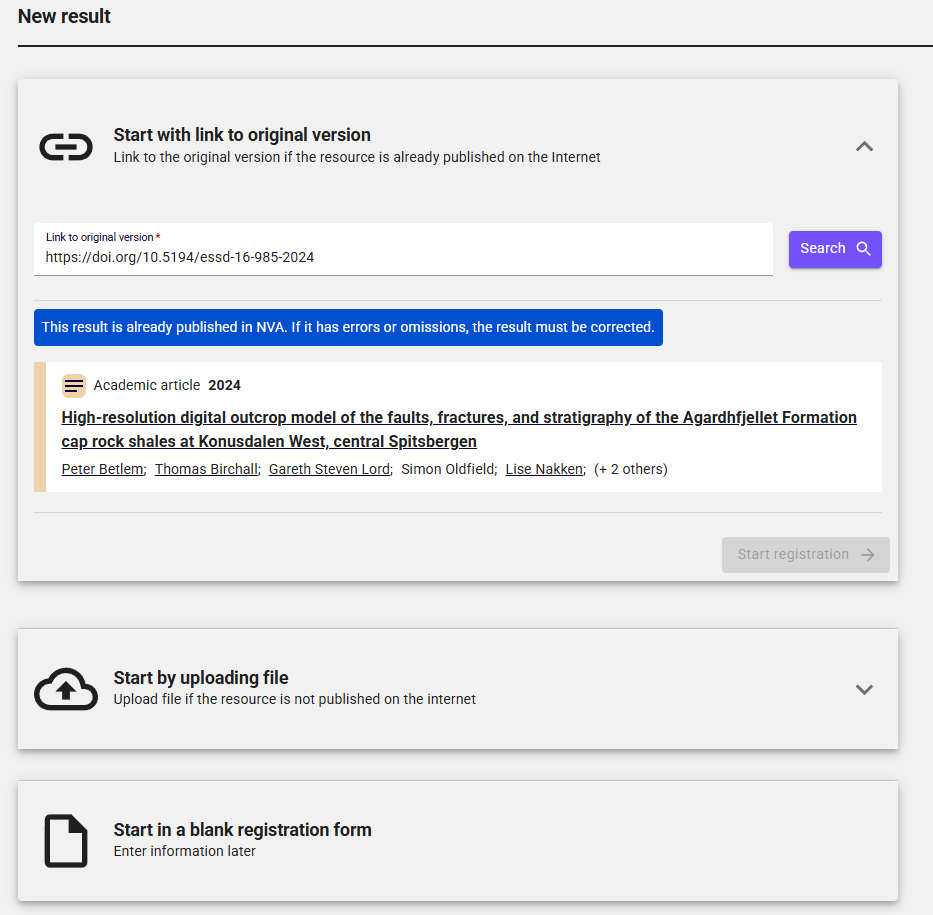
- We also strongly recommend making use of NVA’s “Start with link” feature. It will attempt to automatically detect whether the article is already registered in the system or not. It will also attempt to extract information from the source link to fill out registration fields for you (results are best when using a doi, but other kinds of links also work).