
Strategy 2030
About the strategy
The Arctic is warming at more than twice the global average, and Svalbard is among the most rapidly changing regions on Earth. Understanding how nature responds is increasingly vital for management, security and preparedness in Svalbard and the High North.
UNIS’s year-round presence in Svalbard provides unparalleled opportunities for field-based research and education, while contributing to long-term monitoring of environmental change. From this vantage point, Svalbard serves as a frontline observatory for global change. Here, climate change is not a distant prospect — it is unfolding now. At the same time, we have to ensure that our activities are safe, responsible, and leave the lowest possible impact on fragile ecosystems.
This strategy strengthens UNIS’s position as a key hub for Arctic research and education. Together with our partner universities — in line with the joint positioning paper signed by all Norwegian universities — we will drive national and international collaboration. UNIS will contribute to major initiatives such as the International Polar Year 2032–33 and Polar Ocean 2050, and will be the Arctic campus that educates the experts that society needs to confront the challenges of a changing North. Through firsthand experience in the field, our students are prepared to meet challenges that carry global significance.
The strategy was developed through an inclusive process involving input from partners, internal staff workshops, and board-level discussions. It is guided by the mandate of the Ministry of research and higher education and shaped by key national policy documents, including the most recent Svalbard White Paper. It reinforces UNIS’s role in advancing Norway’s strategies for Svalbard.
The UNIS Board of Directors approved the strategy December 2025.
Key national policy documents
- Mandate and yearly letter of allocation by the Ministry of Research and Higher Education
- Strategy for Research and Higher Education in Svalbard (2018)
- Innovation and Business Development in Svalbard (NFD, 2019)
- Long-term plan for Research and Higher Education (2023-2032)
- National Digitalisation Strategy (2024-2030)
- Svalbard White Paper (Meld.St.26: 2023-2024)
- Norge i Nord, Nordområdepolitikken i en ny virkelighet (2025)
Other:
Positioning document for Strategic Collaboration between Norwegian Universities and UNIS (2024)
climate change is not a distant prospect
— it is unfolding now
About UNIS
The University Centre in Svalbard (UNIS) located at 78°N, is the world’s northernmost higher education institution. UNIS offers Arctic-focused education at bachelor, master, and PhD level in collaboration with Norwegian universities.
UNIS is a state-owned limited liability company under the Ministry of Research and Higher Education, governed by a Board of Directors appointed by the Ministry. This governance framework ensures that UNIS’s activities align with national strategies for Svalbard.
Academic activities span five disciplines:
- Arctic Biology
- Arctic Geology
- Arctic Geophysics
- Arctic Technology
- Arctic Safety
Learning is field-based, and courses are accredited by Norwegian universities.
UNIS supports both internal and external research through its field logistics units, ensuring safe and low-impact operations in the Arctic. Research-based knowledge is applied in daily safety assessments, and mandatory training ensures that all activity is conducted responsibly in one of the world’s most challenging environments. In addition, the logistics unit shares its expertise with the local community by offering safety courses and strengthening Longyearbyen as a knowledge-based society.
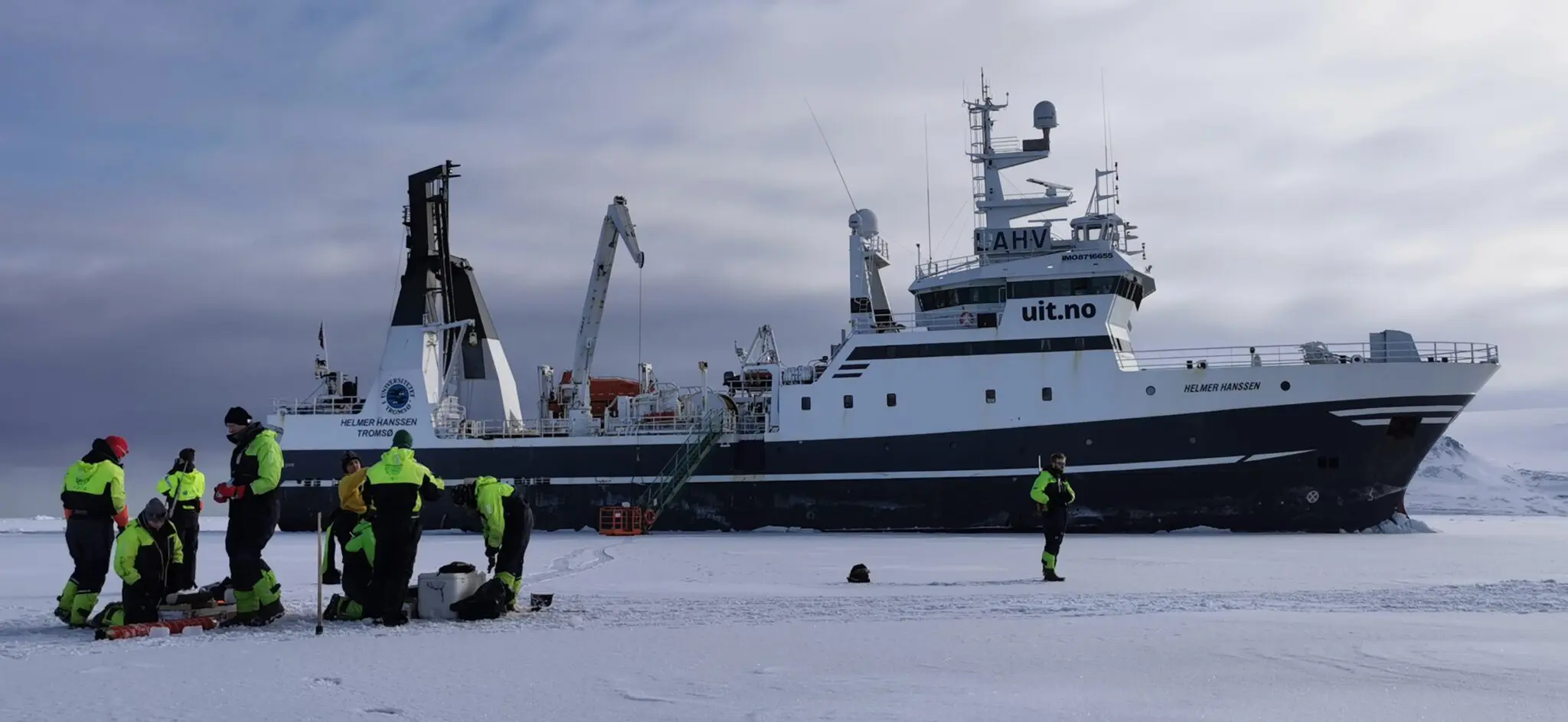
Activities are concentrated in Longyearbyen, Svea, and Ny-Ålesund. UNIS operates large research infrastructure, including the Kjell Henriksen Observatory and the SuperDARN radar, and the research vessel M/S Hanna Resvoll. Svea is currently being developed to host a Research and environmental conservation program.
UNIS hosts SIOS – the Svalbard Integrated Arctic Earth Observing System – which is an international observing system for long-term measurement in and around the Norwegian archipelago of Svalbard addressing Earth System Science.
Additionally, the Arctic Safety Centre, hosted by UNIS, builds Arctic safety expertise and offers training to researchers, local stakeholders, and businesses.
UNIS facts
- Established 1993, Longyearbyen 78¨N
- Student production: 220 student year equivalents (BSc/MSc/PhD). 50% of students from Norwegian universities.
- Resident staff: 53 research staff, 40 administrative/technical staff.
- Other staff: 33 adjunct professors, 137 guest lecturers.
- Arctic Science Index: 1,19 (19% above average).
- Student success rate: 99%.
- Language: Administrative (Norwegian), Teaching (English).
- Best university town in Norway: Longyearbyen 2023, 2024 2025
Positioning paper
In 2024 UNIS and the Norwegian universities signed a position paper to increase research collaboration, student recruitment, and staff recruitment. This joint initiative helps secure a balanced recruitment mix between Norwegian and international students, thereby strengthening Norway’s position as a leading nation in polar research.
Ambitions
- UNIS will prioritise research initiatives that build excellence through consolidation and collaboration, setting clear goals for high-impact research, and striving to strengthen its external, competitive, funding.
- Being located at the epicentre of climate change, UNIS will prioritise research to develop innovative strategies for managing challenges of local, regional and global importance (e.g. permafrost thawing, freshwater resources, renewable energy, and natural hazards).
- UNIS will prioritise continuation of long-term observations of key environmental parameters and drive innovation in advancing new observation technologies. Integrating digitalisation skills into our study programmes will broaden the recruitment base from the mainland universities. UNIS data will be shared through the Svalbard Integrated Arctic Earth Observing System (SIOS).
- UNIS will maintain international leadership in field-based education and serve as the Arctic campus for flagship initiatives such as Arctic Ocean 2050 and the International Polar Year 2032–33.
- All field activities will be conducted responsibly, avoiding disturbance of wildlife, and minimising the environmental impact, which will be monitored. UNIS has set a target to reduce the institution’s total CO2 emissions by 50% by 2030, using the 2018–19 average as a baseline.
- UNIS will strive to be an inclusive and attractive workplace that fosters professional growth throughout employees’ careers. All permanent staff will be supported in learning Norwegian and contributing to Longyearbyen as a knowledge-based community, both academically and socially.
- UNIS will professionalise strategic communication, ensuring that UNIS’s knowledge is visible, accessible, and relevant to researchers, students, partners, and society at large — locally, nationally, and internationally — in line with Norway’s higher education policies and the Svalbard White Paper
UNIS converts national ambitions into knowledge, expertise, and a sustained presence in the High Arctic
Direction for UNIS given by the Svalbard white paper (Meld.St.26: 2023-2024)
The Government will:
- Continue the strategies as well as the following objectives and frameworks for research and higher education in Svalbard, derived from them:
- Research activities and educational programmes shall be based on the natural advantages provided by Svalbard’s location.
- The research environments shall have the highest scientific ambitions for their research and strive for quality through international cooperation.
- Research data and results shall be made openly available, shared and published in such a manner that they contribute to the development of the research front.
- All research and educational activities shall take into account the need to minimise the footprint and overall impact on the environment.
- Work towards a more systematic and binding cooperation regarding the research infrastructure in Svalbard.
- The research environments shall share information about planned projects in the field
- and coordinate activities as far as possible.
- All researchers, students and institutions that are active in the field must possess the appropriate competence and have the necessary logistical support.
- Research in Svalbard shall primarily be conducted from established local communities and research stations.
- UNIS shall be the sole provider of higher education in Svalbard.
- Ensure that UNIS continues to develop its role and profile as one of the most important institutions in Norwegian polar and Svalbard research and higher education.
- Ensure that UNIS further develops its collaboration with the mainland universities in order to strengthen recruitment and the quality of the courses offered.
- Consider a target of employing Norwegian professionals at UNIS.
- Consider various measures to increase the proportion of Norwegian students at UNIS.
- Ensure that the Arctic Safety Centre (ASC) is further developed for research and education purposes.
Research in a changing Arctic
A year-round presence and a broad national and international network are essential for UNIS’s research success. Svalbard will act as a natural laboratory for high quality, interdisciplinary research on pan-Arctic challenges across our main areas:
Arctic biology, geology, geophysics, technology, and safety, with a strong emphasis on innovative methodologies. To meet future needs relating to the changing environment, we will maximise the global, regional, and local impact of our research.
UNIS will be at the forefront of Arctic research,
fostering research exellence
Main objectives
UNIS will:
- Address research questions and societal challenges with global, regional, and local impacts.
- Achieve research excellence through strategic consolidation and collaboration, enhancing interdisciplinary research.
- Maintain and establish internationally recognised research centres and observation infrastructure that leverages our unique location and year-round-presence.
- Develop, test, and operationalise innovative observation technologies to support advanced year-round field campaigns and long-term monitoring. All
research data shall be openly available to provide a comprehensive understanding of the Arctic system. - Be a key partner in international research initiatives including Arctic Ocean 2050 and the fifth International Polar Year (2032-2033)
- Double its external funding of research projects as the basis for developing and expanding strategic research infrastructure, ensuring high-quality data collection, and increased research collaboration.
- Through strategic communication, ensure that our research is accessible, relevant, and visible to society – and promote the institution’s role as a local, national and international knowledge institution.
Arctic education for global challenges
As the sole provider of higher education in Svalbard, UNIS offers research-based education with an unique field component that fully leverages the high Arctic location year-round. The education is student-centred, employs active learning methods, innovative pedagogy, and involvement in authentic research projects at BSc, MSc, and PhD levels.
UNIS offers a national study pathway
to an Arctic specialisation
Main objectives
UNIS will:
- Provide unique and attractive, high-quality, study opportunities, recruiting 220 student full-time equivalents annually, with at least 50% from Norwegian universities
- Expand our role as an international leading institution in field-based education, building on our established expertise through centres of exellence in education
- Increase integration between education and research by being an Arctic campus for initiatives such as Arctic Ocean 2050 and the International Polar Year 2032–33
- Have BSc and MSc students spend a minimum of one full semester at UNIS, enabling them to participate in research and gain experience with the seasonal changes in
the Arctic - Develop a new Master of Polar Science program to attract and retain top students from natural sciences and technology programs
- Emphasise the competitive advantages that UNIS education provides for a future career and promote our students as the next generation of Arctic experts
- Expand the recruitment base by further developing an inclusive and welcoming learning environment that attracts and supports a diverse student community and fosters engaged learning
- Continuously improve the course portfolio to meet student recruitment targets with sustainable use of workforce capacity, financial, environmental and logistic resources
Sustainable research and education in the Arctic
Svalbard faces significant challenges across various areas, with the most urgent being dramatic changes in the natural environment, geopolitical security concerns, and shifts in the economic base and demography of Longyearbyen. Many of these issues are mainly driven by climate change.
The interaction between multiple, simultaneous challenges— and their mutually reinforcing adverse effects—means that measures must be evaluated within their context and approached holistically to achieve the desired impact.
UNIS has selected the central areas that form the institution’s foundation and framework to understand challenges in a sustainability context and implement the most effective measures.
UNIS will conduct its activities
without compromising the
economy, workers’ welfare or field safety
Main objectives
UNIS shall be an innovative institution dedicated to sustainable operations in the Arctic, offering research and education to deepen our understanding of Arctic system dynamics, protect the natural environment, mitigate climate change, and support adaptation to its impact. UNIS will carry out its activities without compromising the worker welfare, the natural environment, field safety, security, or economy.
UNIS will:
1. Working environment
Aim to be a professional, innovative, and efficient organisation recognised as an attractive employer with an excellent reputation for workplace culture. UNIS staff members foster a positive, fair, inclusive, safe, and transparent working environment, reflecting our core values.
2. Protecting the natural environment
Champion efforts to reduce the environmental footprint of human activities in the Arctic. We commit to lowering the greenhouse gas emissions of our operations by 50% from 2018 to 2030.
We will minimise the environmental impact of our research and teaching activities. We will play a significant role in Longyearbyen’s transition to renewable energy solutions by providing the scientific basis for societal transition efforts.
3. Mitigating impacts of climate change
Leverage our expertise and resources to deepen understanding of the local, regional, and global impacts of Arctic warming. We will develop innovative technology and operational procedures to mitigate these effects, enabling safe living and working in the high Arctic.
4. Field safety
Ensure the safety and well-being of all participants in Arctic field operations. We will be a leading provider of courses and training in field safety, offering the local community knowledge tailored to the evolving natural hazards.
5. Security and preparedness
Oversee societal security, preparedness, information security, and privacy in accordance with national guidelines, academic norms, values, and principles of international collaboration.
6. Economy
Enhance our resource management and competitiveness to ensure a sustainable economy and strengthen our external funding.
7. Infrastructure
Maximise the use of existing resources and take a lead in developing a modern national Arctic infrastructure to support operations, projects, and future growth.
8. Dissemination and social responsibility
UNIS is committed to actively support the local community by sharing our research, knowledge, and expertise in a strategic manner. Through open dialogue and effective communication, our students and staff will engage with the community both academically and socially. This involves encouraging collaboration with local institutions and businesses, as well as promoting well-being, inclusion, and sustainable development in Longyearbyen.
Definition of sustainability:
For UNIS, the sustainability concept includes a broader understanding of the UN Sustainable Development Goals. Sustainable development involves satisfying the needs of the present without jeopardising the ability of future generations to meet their own. The definition is divided into the following pillars:
Environmental sustainability: Preservation of natural resources and ecosystems.
Economic sustainability: Ensuring long-term economic growth and stability.
Social sustainability: Protecting social rights, promoting inclusion, and safeguarding welfare.
At UNIS, social sustainability also includes the working environment, field safety, and emergency preparedness and response.